
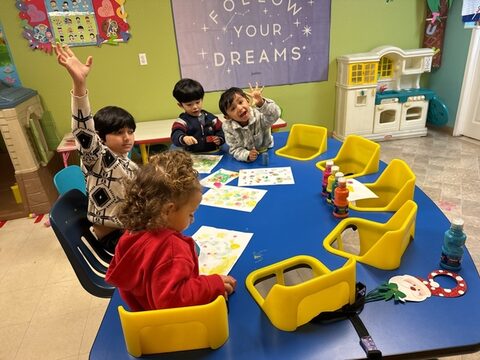
Young children are natural scientists. They pick things up, turn them over, drop them, stack them, and take them apart. This hands-on exploration is not just play — it is how children under age six build the neural pathways that support cognitive development. Research in early childhood education consistently shows that tactile, experiential learning produces deeper understanding and better retention than passive instruction for children in this age group.
Make concepts movable
Use physical objects to represent abstract ideas. Blocks for counting, lids for sorting by size or color, toy animals for storytelling, and safe household objects for comparing textures. When a child can hold, stack, and rearrange, the concept becomes real rather than theoretical.
Try a sorting activity: gather a basket of mixed objects — buttons, blocks, toy cars, kitchen utensils — and ask your child to group them by color, shape, or size. Sorting builds classification skills, a foundation for mathematical thinking.
Add movement to memory
The body and brain are connected. When children move while learning, they encode the information more deeply. Clap syllables of words. Step along an imaginary number line, calling out each number. Form shapes with your arms — a triangle, a circle. Act out the sequence of a story: first the bear woke up, then he walked through the forest, then he found the honey.
Movement also helps children who struggle to sit still. If your child fidgets during reading time, try reading while standing, or act out the story together. The movement does not distract — it helps the child process.
Invite children to make something
Drawing, collage, play dough, building with blocks, construction with cardboard, and pretend play all ask children to plan, choose materials, adjust when things go wrong, and explain their thinking. These are the same cognitive processes scientists and engineers use, scaled down to a child's world.
Set up a simple art station at home with crayons, paper, child-safe scissors, glue, and recycled materials. Let your child decide what to make. Avoid directing the outcome — the value is in the process of deciding, trying, and problem-solving, not in producing a specific finished product.
Keep the goal clear
An activity does not need many materials to be meaningful. Name the idea you want to explore, demonstrate briefly, let your child try, and talk about what happened. If the goal is counting, use three blocks and count them together. If the goal is color recognition, name the colors of items in your kitchen. Simplicity keeps the learning objective clear and prevents the activity from becoming overwhelming.
Hands-on learning at Bubbly Tots
At Bubbly Tots Learning Center, every classroom is designed for tactile exploration. Our curriculum includes sensory tables, art stations, block building areas, and outdoor play spaces where children learn through touch, movement, and construction. Teachers rotate materials regularly to keep activities fresh and developmentally appropriate for each age group.
FAQ
What age is hands-on learning appropriate for?
Hands-on learning is appropriate from birth through early elementary school. For children under six, it is the primary way they build understanding of the physical and social world.
Do I need special materials for hands-on learning at home?
No. Kitchen items, recycled materials, blocks, art supplies, and outdoor objects are all you need. The best hands-on activities use everyday items in creative ways.
How does hands-on learning support kindergarten readiness?
Hands-on activities build fine motor skills (writing, cutting, buttoning), cognitive skills (counting, sorting, patterning), and social-emotional skills (sharing materials, waiting turns, explaining ideas). All of these are foundational for kindergarten success.
Want to see a hands-on learning environment in person? Schedule a tour at Bubbly Tots Learning Center or call/text 510-351-0300.
Explore learning at Bubbly Tots
See how caring routines, play, and family communication come together in our San Leandro programs.
Explore programs